Today is the anniversary of one of the greatest photographs of World War II being taken — and of a defining moment in British history. On the night of December 29, 1940, Daily Mail chief photographer Herbert Mason was firewatching on the roof of the newspaper’s offices between Fleet Street and the Thames.
The Luftwaffe’s blitz on London was at its height: after a brief pause decreed by Hitler on Christmas Day, Goering’s bombers had resumed their almost nightly pounding of the capital. A brief attack on December 27 inflicted 600 casualties, more than 50 of them in a single public shelter in Southwark which received a direct hit.
 Symbol in the smoke: Herbert Mason's iconic photograph of St Paul's dome emerging from the smoke of raging fires in surrounding streets was taken 70 years ago this week
When darkness fell on December 29, the Heinkel and Dornier planes came again to launch their 125th attack since the campaign began — which inflicted unparalleled devastation on the old City of London. Barely 30 minutes into the raid, Luftwaffe aircrew counted 54 major fires beneath them; in three hours of early evening bombing, 120 tons of explosive and 22,000 incendiaries fell, inflicting appalling damage.
 Capturing history: Daily Mail chief photographer Herbert Mason took the photograph from the roof of the newspaper's office in Carmelite Street
Hundreds of buildings in the heart of the financial district were set ablaze; eight Christopher Wren churches were destroyed and the 15th-century Guildhall was set on fire. One bomb landed near the Monument, erected by Wren to commemorate the 1666 Great Fire of London.
A middle-aged spinster named Vere Hodgson, who worked in a charity shop in Notting Hill, kept a wonderful diary of the war years, especially of the Blitz. ‘Terrible fires in London,’ she wrote of that night. ‘We went up on the roof to look. At Shepherd’s Bush, flames were leaping, and towards the City they were gigantic. As I walked up the road I could see the smoke.
‘A great red glow filled the sky — I had no need of a torch — I could see every step I took and could have read a book if I had wished.
‘The police said it was Waterloo station, but a taxi man told my friend Miss Mowes that the City was on fire, and they were trying to save St Paul’s. These were her first words to me, and I shall never forget the horror of them.’
On the roof of the Mail’s office at Northcliffe House, Carmelite Street, Herbert Mason gazed on the inferno around the cathedral, less than half a mile from where he stood — and raised his camera.
‘I focused at intervals as the great dome loomed up through the smoke,’ he later said. ‘The glare of many fires and sweeping clouds of smoke kept hiding the shape. Then a wind sprang up. Suddenly, the shining cross, dome and towers stood out like a symbol in the inferno. The scene was unbelievable. In that moment or two, I released my shutter.’
Mason knew nothing of the extraordinary drama taking place in St Paul’s, even as he took the picture that became the transcendent image of the Blitz.
 Devastation: This was the view from St Paul's on January 3, 1941, showing the destruction to the streets surrounding the Cathedral
Falling rubble had blocked emergency services from getting through the streets and an abnormally low tide in the Thames caused hydrants on which firemen’s pumps depended to run dry. When a fire broke out in the cathedral’s library aisle, there was no mains water to fight it — the blaze was eventually suppressed with stirrup pumps, buckets and sand.
 The War's greatest picture: The Daily Mail of 31 December 1940 sums up Herbert Mason's picture in perfect style.
Then, soon after 6.30pm, an incendiary bomb — one of 29 to fall on and around St Paul’s that night — pierced the lead roof of the dome and lodged in its timbers. Molten lead began to drip into the nave below. The aged wood of the choir stalls and organ screen, carved by the great sculptor Grinling Gibbons, was at mortal risk, while smoke from the blazing buildings surrounding the cathedral enveloped it.
American reporter Ed Murrow pronounced the great building’s obituary in a live broadcast to the U.S.: ‘The church that means most to London is gone. St Paul’s Cathedral is burning to the ground as I talk to you now.’
His valediction was premature: as he spoke, two teams of specialist fire watchers recruited from the Royal Institute of British Architects — and hand-picked because they had heads for heights — were crawling along the wooden beams with hand pumps to reach the blazing section.
But suddenly the incendiary bomb, having burnt through the wood, fell far, far to the nave below, where it was easily put out. Though almost every building around St Paul’s perished, the cathedral survived.
More than 160 people died in that night’s raid, including 16 firemen, and 500 were injured.
Eight of the firemen perished in a single incident when a wall collapsed on them as they fought a blaze near Fleet Street and 250 of their comrades suffered injuries during the night.
The next morning, it was bitterly cold. There was a light scattering of snow as office worker Dorothy Barton emerged from London Bridge station on her commute.
She gazed in horror at the acres of smoking and still burning ruins —then her heart lifted as she looked up at St Paul’s, towering over the scene. ‘I felt a lump in my throat because, like so many people, I felt that while St Paul’s survived, so would we,’ she said.
 London's burning: Ruins of a building in the shadow of St Paul's still smoulder a week after the Blitz on the city in December 1940
But mild, gentle Miss Vere Hodgson looked on the devastation and wrote bitterly: ‘I shall never bother with Germans or foreigners again. It makes you want to give other people a taste of what we have had.’
Herbert Mason’s photograph went unpublished for two days while censors considered whether it would serve Britain’s cause; others — for example, one of Bank underground.


 Under their mother's ever watchful eye, the unskilled hunters watch for vulnerable prey in the planes of the reserve.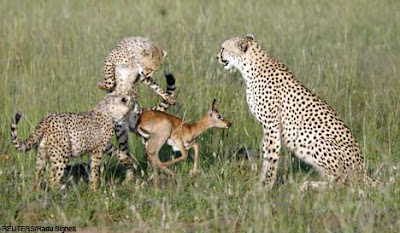
 The experienced hunter corners and catches the prey and brings it to her offspring so they can learn to do the same.
 Hunting is the most important lesson the cubs can learn from their as these newly honed skills not only ensure they can hunt for food, but also enables them to avoid predators such as eagles.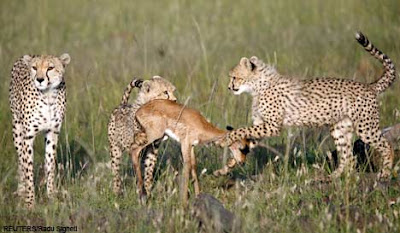


 A tourist has a photo taken besides a cypress, on July 24, which bears a scar closely resembling a human ear in shape.The cypress, at least 900 years old, stands in front of the Taihao Mausoleum of Huaiyang county, central China’s Henan province.
